
For a long time, shop owners treated AI Overviews as a blog problem. “Best running shoes” might get a summary. “Buy RGB-W 4-core cable 0.6 m” still looked like a row of blue links and Shopping ads. That split is closing.
In March 2026, Search Engine Land reported Visibility Labs’ study of 20.9 million shopping keywords — queries tied to a Shopping box, paid or organic. About 2.92 million of them, 14%, triggered an AI Overview. In November 2025 the same kind of set sat near 2.1%. That is a 5.6× jump in four months, on terms like weighted blanket, protein powder and blue T-shirts — not only encyclopaedia questions.
Fourteen percent is not “every product search.” Transactional queries still often keep classic results. It is enough that mid-funnel shopping research — compare, “best for”, “which size” — now sometimes answers before the click. If your product page is a pasted manufacturer block, there is little for that box to quote except the same text ten other shops already published.
Google’s official line: it is still SEO
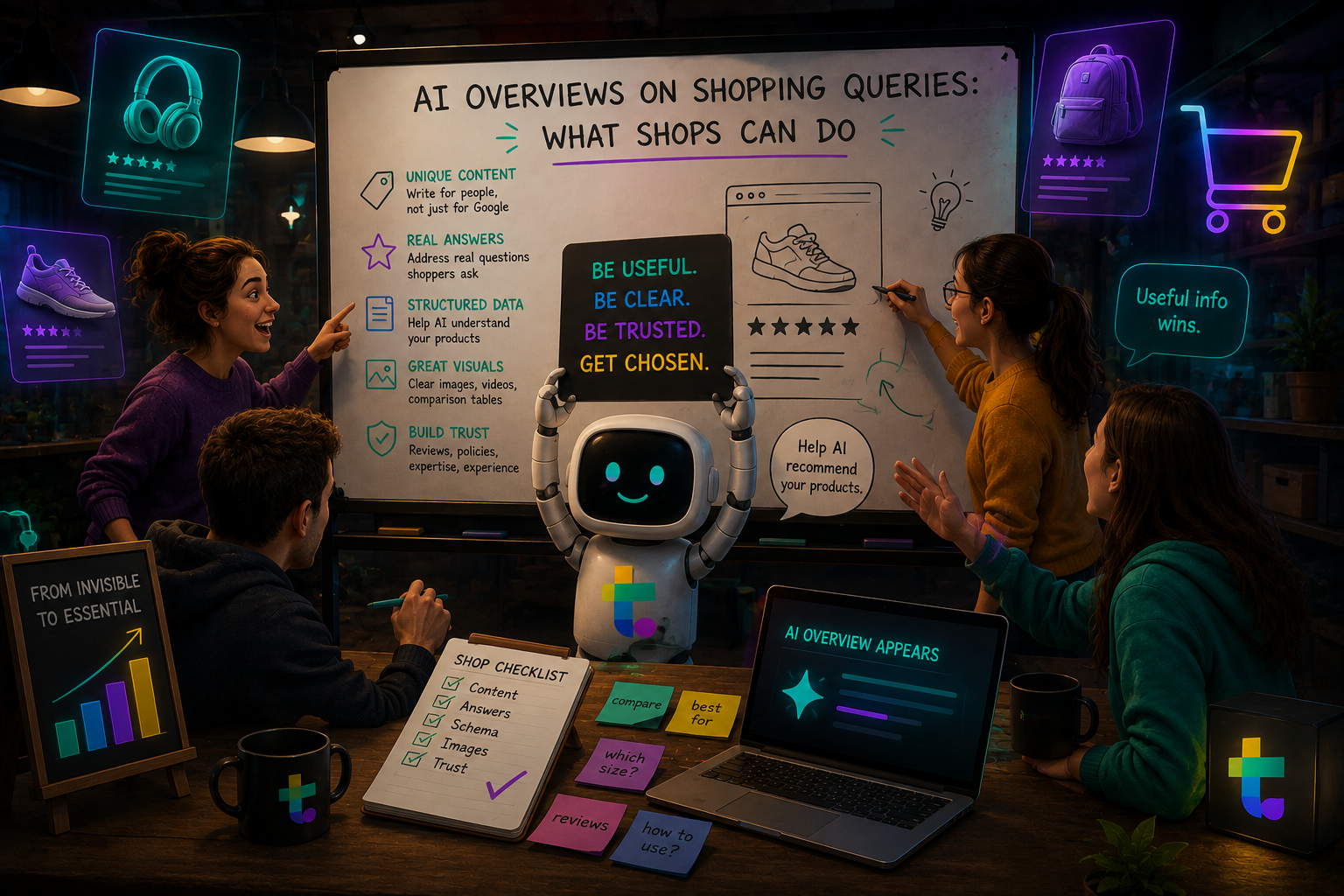
Google Search Central’s guide to generative AI features (updated through 2026) is blunt. Appearing in AI Overviews or AI Mode is not a separate sport with a secret schema. The page must be in the normal Search index and eligible for a snippet. Optimising for those features, Google says, is still SEO: crawlable HTML, unique useful content, technical hygiene.
The same document tells you what to ignore for Google Search itself: special “AI files”, breaking copy into artificial chunks, a writing style invented for models, and fake mentions around the web. Structured data is not required for generative features, though Product markup still helps classic rich results. If you use nosnippet or crush snippets, you can lock yourself out of both the old snippet and the AI box.
That is good news for a WooCommerce catalogue. You do not need a second website for “AEO.” You need product URLs that a crawler can fetch, that a human can use, and that say something the datasheet on the next domain does not.
What a product page must contain if a summary is going to use you
Think like the question, not like the warehouse. Shoppers — and summaries — look for fit, limits, materials, size, what is in the box, and how this SKU differs from the cheap twin. A page that answers those in short, factual blocks is easier to lift than a 2,000-word adjective pile.
Keep the facts on the server-rendered page, not only in a tab that never ships in HTML. Price and stock belong in visible content and, if you use it, in Product structured data that matches the page. When HTML, schema and the Merchant feed disagree, machines trust you less. Variants need their own honesty: the red SKU’s copy and image should be red.
Internal links to the real category, not to a junk tag archive, help the product sit in a catalogue Google already understands. Thin tag URLs and filter parameters, which we covered in earlier pieces, still waste crawl that should have gone to the SKU you want cited.
Do not expect a guarantee. Citation is not a ranking you buy. The job is to be the least replaceable source for that product: specific, current, not cloned.
How you know it moved
Search Console is adding reporting for generative AI surfaces (impressions first, and not on every property yet). Use it when you have it. Until then, the old scoreboard still applies: baseline the product URL, rewrite the unique parts, wait for recrawl, compare clicks and impressions on equal windows. If AI Overviews eat clicks on “best X” queries, that can show up as fewer clicks with steady impressions — another reason not to read CTR in isolation.
Manually: pick ten money queries, search them logged-out, note whether an Overview appears and whether your domain is a supporting link. That is a sample, not a dashboard. Combine it with the GSC export, not with a vibe.
TraFixi can help you ship unique titles, metas and descriptions and keep a before/after on the URL. It cannot promise an Overview citation. Nobody honest can.
Shopping search is no longer a sealed room. The shops that stay visible will look like the ones that always should have: crawlable pages, true product facts, copy that is not shared with forty competitors. The Overview is a new frame. The work inside the frame is the same.