

You rewrote forty product descriptions. Titles look cleaner. Someone on the team says organic “feels better.” That is not a result. That is a mood. SEO work without a scoreboard is just hope — and hope does not tell you whether to repeat the rewrite, stop, or roll it back.
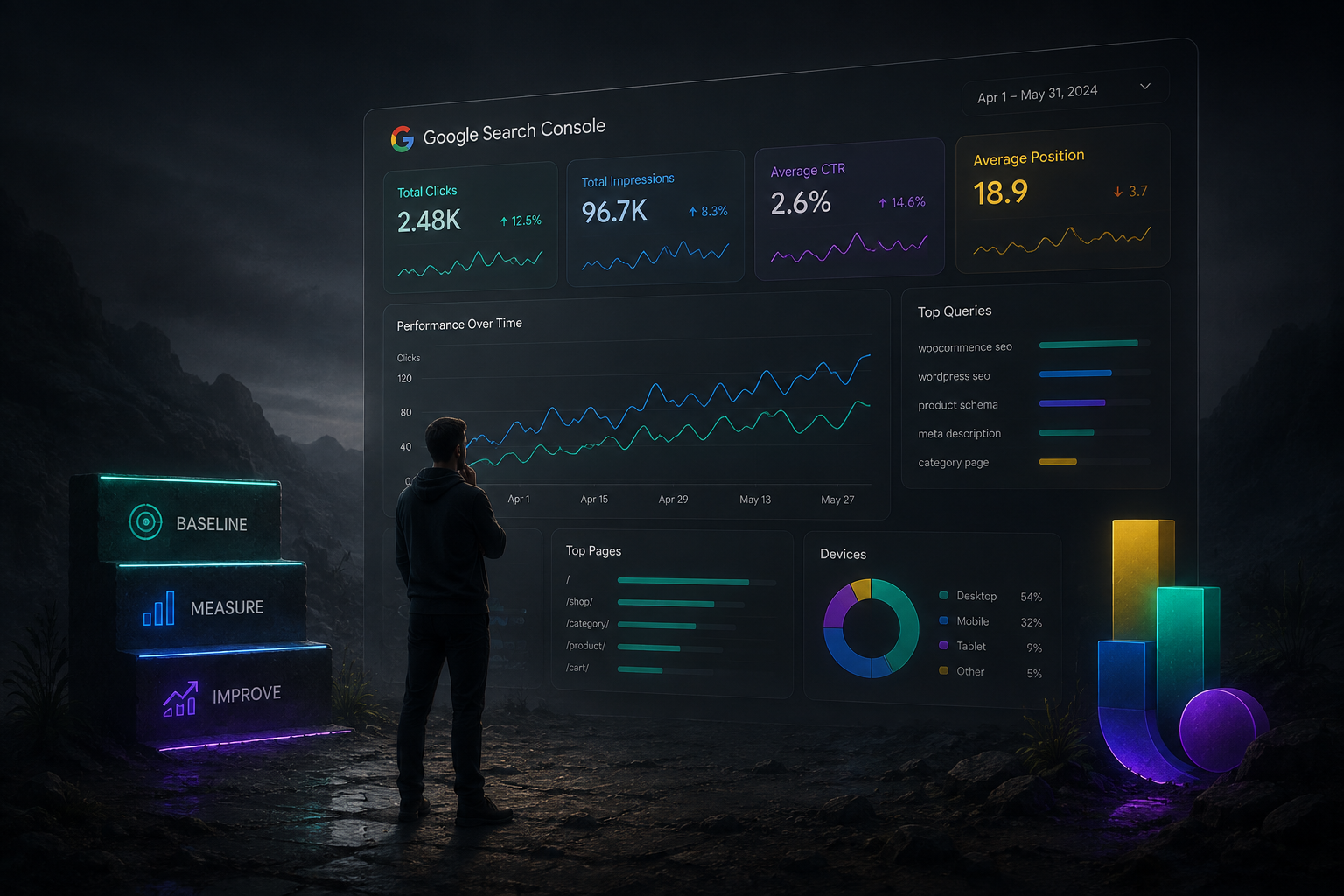
The scoreboard for a WooCommerce shop is not a plugin gauge on a product card. It is how Google actually showed you, and whether people clicked. Google Search Console’s Performance report is the source of truth: impressions, clicks, average CTR and average position, for a URL or a query, over dates you choose. Third-party rank trackers estimate. GSC reports what Google recorded.
Save the before. Do not reconstruct it later
Rankture’s measurement guide starts in the unglamorous place: capture the page before you publish. URL, date, the action you will take, impressions, clicks, CTR, average position, index status if you care, and any context (sale, migration, stock-out). Do not rebuild that snapshot from memory two weeks later. Counted metrics (clicks, impressions) and averaged ones (position, CTR) do not behave the same in a comparison. Mixing them without looking is how “we improved by 0.3 positions” becomes a slide.
For a shop, the unit is usually one product URL or one category URL — not the whole domain. Filter Performance by page. Export the window. Write the date you will hit Apply. If you change twenty SKUs in one afternoon, treat that as a batch with one start date, then judge the batch and a few hero URLs so one noisy product does not define the story.
A seven-day glance can catch a disaster: the URL dropped out of the index, the title vanished from the snippet, clicks fell off a cliff. Rankture is clear that a week is usually too short for a content verdict. Their practical default is to compare a later slice (they use days 21–28 after publish) with the saved baseline. Content Raptor’s before/after framework lands nearby: two to four weeks on each side of the change, same length, so you are not comparing a busy weekend to a quiet Tuesday. Three weeks is a decent default. Under about ten clicks a day, stretch to four so the percentages are not theatre.
Wait for recrawl. URL Inspection in Search Console shows last crawl. Content Raptor’s advice is to start the “after” window from recrawl, not from the minute you saved the product. Google Search Console data also lags two to three days, as Rankture notes. The last days of any window are incomplete. Use closed date ranges of equal length.
Four numbers, four different jobs
Impressions: did Google show the URL more often, or for more queries? That is visibility. Clicks: did anyone arrive? That is traffic. CTR: of the times you were shown, how often did people choose you? That is the snippet — title, description, perhaps rich result. Average position: where you sat when you were shown. Rankture’s warning is the right one: treat tiny position wiggles as no movement. Content Raptor’s rule of thumb is similar — a couple of places can be signal; half a place is noise.
Different edits test different things. A title and meta rewrite is mainly a CTR test. Expanding the description and adding real attributes may first lift impressions (new queries) before clicks catch up. An internal-link pass may help discovery. A technical fix can be a win when the URL is indexed again, even before traffic grows. If you only watch position, you will call a good title change a failure because the average stayed on page two — or call a query expansion a failure because CTR dipped while impressions rose. Content Raptor explains that pattern: new, weaker queries inflate the impression denominator. Overall that can still be progress.
RankAI’s rewrite-measurement guide adds the catalogue view: it is often cheaper to refresh URLs Google already knows than to invent new ones. In GSC, compare the last three months with the three months before that, and look for pages whose clicks or impressions are sliding. Those are your scoreboard candidates — not random SKUs you happened to open.
Season, site, and small numbers lie
If the edited URL fell 20% and the rest of the shop fell 22%, the rewrite probably held. Rankture calls a site-level line the cheapest seasonality check you have. Year-on-year helps when you have a year of GSC. A core update, a price change, or a stock gap in the same window should be written on the note, and confidence should go down. “The page improved after the change” is honest. “The rewrite caused every click” is usually not, unless you ran a real experiment.
A real experiment, if the catalogue is large enough, is RankAI’s SEO split: similar product pages in a control group and a variant group, one change, several weeks, then compare deltas. Most shops will not run that every week. They can still refuse to publish “+300%” when three clicks became twelve. Rankture’s rule: print absolute numbers next to percentages, or skip the percentage. Insufficient data is a verdict, not a polite word for “neutral.”
Keep the misses. A rewrite that did nothing is information. Deleting failures from the story is how you repeat the same empty HTML pass for a year.
A shop-floor scoreboard
Before you touch the listing, export GSC for that URL: last 21 or 28 days, clicks, impressions, CTR, position. Write the hypothesis in one line: “Unique description should lift impressions for [product type] queries,” or “New title should lift CTR.” Apply. Note the date. After recrawl plus an equal window, export again. Compare. Classify: improved, neutral, declined, or not enough data. Then decide the next ten SKUs — or stop.
TraFixi can keep a baseline next to later Search Console figures on the product or post, so the before is not a forgotten spreadsheet. It does not invent causality. You still read the four metrics and the calendar.
Activity is easy. A scoreboard is a date, a URL, two equal windows, and four numbers you are willing to look at when they do not move. Until those exist, the rewrite is only hope with nicer copy.