
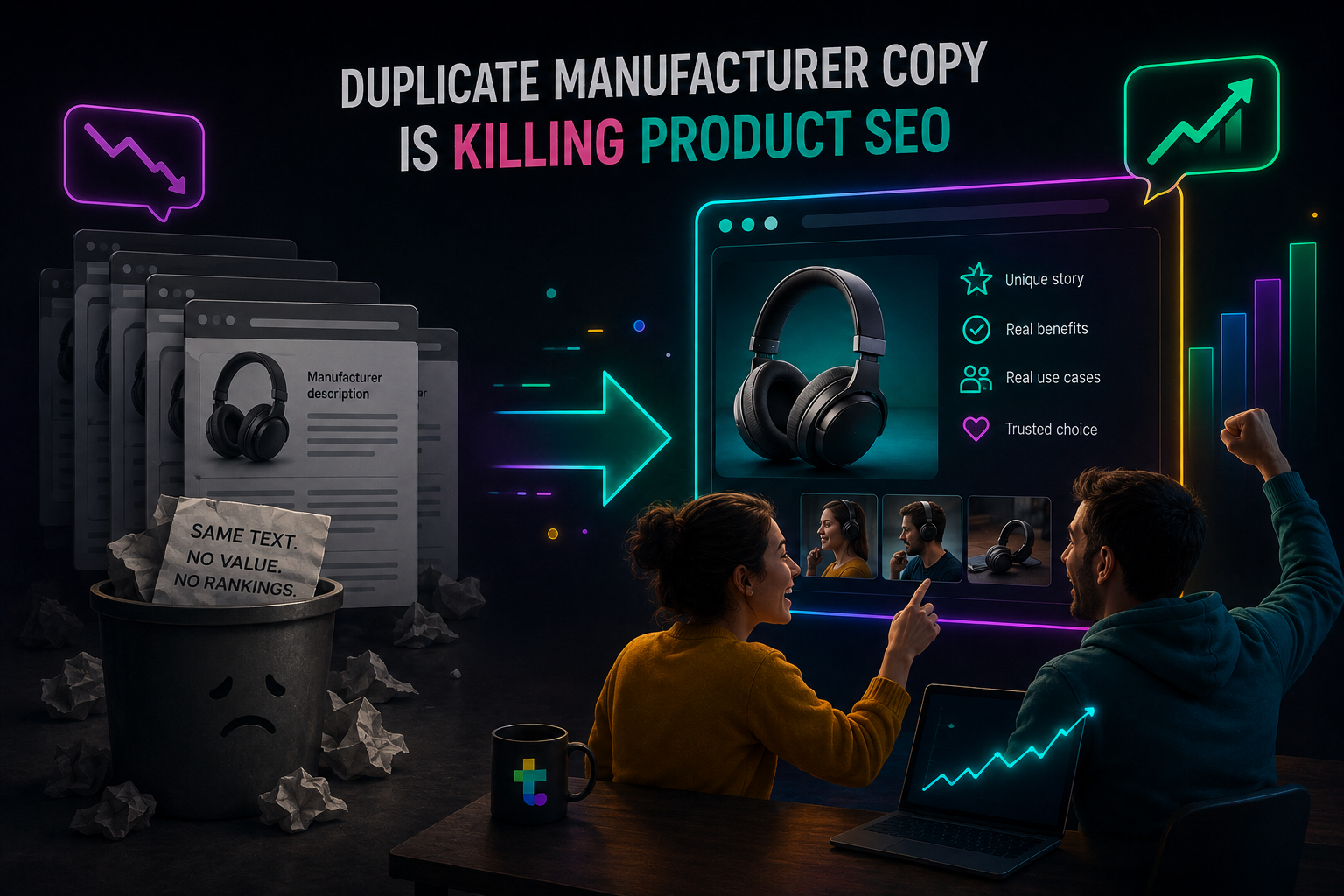

You imported the feed. Title, bullets, “high-quality materials,” a paragraph the brand wrote in 2019. The product is real. The text is not yours. Neither is it unique: the next twenty shops selling the same SKU pasted the same block. When someone searches the model name, Google has a stack of near-identical pages. It does not need forty copies. It picks one — often the manufacturer or the biggest retailer — and the rest sit in the long tail of Search Console with impressions at or near zero.
That is not a folk “duplicate content penalty.” Patrick Stox’s ecommerce notes repeat what Google has said for years: ordinary duplication, by itself, is not a spam strike. Bing says the same. Reusing a manufacturer blurb will not get a manual action labelled “you copied a datasheet.” It also will not help you win the query. Deduplication still happens. Signals split. The wrong URL can be chosen. Crawl is spent on pages that add nothing new.
What does sit in spam policy is different. Google’s scaled content abuse rule (from 2024, still the frame in 2026) targets many pages made mainly to manipulate rankings, with little value for people — whether a human, a template or a model wrote them. A honest catalogue with supplier specs plus your own fit notes is not that. A thousand paraphrased twins of the same PDF, published so you can “own” every SKU string, is closer. The method is not the crime. The empty scale is.
Two kinds of sameness, one shop
External sameness: your long description matches other sites. Search the first sentence in quotes. If page one is full of competitors and the brand, you are in the commodity-text bucket. Internal sameness: two hundred of your SKUs share “Premium quality. Fast shipping. Order today.” Google then struggles to tell products apart on your domain, even if the photos differ.
CrawlSense’s take is the useful one for shops: Google is not scoring “has this paragraph appeared on earth.” It is scoring whether the page as a whole is worth showing. Shared spec tables are normal. Dimensions, voltage, IP rating, SKU — keep them accurate. The part that must not be a clone is the buying layer: who it is for, what it does not fit, how it differs from the SKU next to it, what you learned from returns, what is in the box in your listing.
Spinning the manufacturer text through a synonym tool is worse than leaving it. Patterned “unique” copy is easy to detect and harder to trust. Hiding the supplier block with CSS does nothing; Google reads the HTML. Variants are a special case. If you built separate URLs on purpose (price, stock, photos, real search demand), each page needs enough of its own substance. Do not 301 eight colours together only because the first paragraph repeats — and do not paste the same 400 words onto all eight either. Colour, length, finish: write the difference.
You will not rewrite 8,000 SKUs this month. That is fine
Prioritise. GSC Performance, pages containing your product path, last 3–6 months. Bestsellers and anything with impressions but a rotten CTR go first. Then products you actually care about in the warehouse. The dead tail can wait; a unique sentence on a SKU nobody searches is not the bottleneck.
A practical split: keep the spec block if it is true. Rewrite the short description and the opening of the long one in your voice. Add one thing a datasheet never has — compatibility with your related products, a warning, a real measurement, an FAQ you answer in support. Internal links to the live category, not to junk tags. Then treat it like article 5: baseline the URL, publish, wait for recrawl, compare clicks and impressions on equal windows. If nothing moves, the text was not the only problem — or the query was never yours.
Do the work in the HTML you already have. Flatsome rows, photos, tables: rewrite words in place. A “unique” dump that strips the layout is a different product page, and not always a better one.
TraFixi AI Fix is built for that pass: unique title, meta, focus keyword, short and long copy, with Preserve HTML so the builder stays. You still approve. A model that only reorders the supplier adjectives is still scaled emptiness. Read two sentences before Apply.
Google already knew the product. The manufacturer introduced it. Your job is to be the shop that says something true the PDF does not — on the SKUs that pay the rent — and to prove it in Search Console, not in a feeling that the catalogue “looks rewritten.”